
How do you teach resilience to kids? Often life can naturally be the best teacher due to childhood hardships such as poverty, divorce, and trauma. It’s easy to be trapped in the darkness of those circumstances. Thankfully, the light shines through when we push outside of our comfort zones. This effort helps us see the positive lessons in hardships. In this modern world we are surrounded by excess more than ever before. We are surrounded by endless digital messaging trying to convince us that if we just buy this or that we’ll find happiness. It leaves people empty, distracted, and disconnected from themselves. Any good parent wishes to give to their child more than they had for themselves. The trouble with that is each generation is becoming more complacent and unsatisfied. Parents often want to shield their children from suffering. They avoid letting their children endure life lessons. However, the natural process of learning resilience is lost.
As a young mom my children’s father and I didn’t raise our kids to have much. When we ended our relationship in October 2014 we had even less to offer the kids. My children still always had a roof over their heads, plenty of homemade meals, and toys to play with so they were content. The five years we spent just the three of us, the kids were well aware that I had to work very hard to keep us fed and off the streets. They were helpful and genuinely grateful for all that they had.
The past three years has changed my children significantly. I graduated from college in December 2017 and only had to work one job instead of several by June 2018. Due to the high cost of living I was still struggling, but our quality of life had improved. Once we moved in with my fiancé and had two incomes the kids’ lives had improved significantly. We no longer worried about the possibility of being homeless or affording basic things. They were able to gain more material things and even their own rooms for the first time. The trouble with that is the more they received the less grateful they became.
I noticed the change in my children’s perception in life as they were becoming sucked into the enticing material world. I have always told them to never forget where you came from, yet my words were not making an impact. I was inspired to show them hands on what resilience means. In my opinion the best people to learn resilience from is the indigenous nations of North America. I chose to bring them to the Black Hills of South Dakota as the theft of land is unresolved, and has the opportunity for the next generation to support justice.
Day 1: Honor the Past
We left our home at 4 am on the first Monday of fall break and headed northeast to South Dakota. I scheduled a 10 am tour at Red Cloud Indian School Heritage Center. We arrived at the Pine Ridge Reservation border checkpoint for registration and affirming we did not have COVID symptoms. That was a smooth process and we headed over to our tour. My heart was heavy as we crossed the border as I could feel the injustice the Oglala Lakota Nation had endured. We arrived just on time to meet our tour guide and I was grateful that we had a private tour for the three of us. I did not take any pictures out of respect, but it is my hope that the lessons of reservation life will be embedded in my children’s minds. We leaned about the tragedy of forced boarding schools which had the goal of eradicating the native children’s heritage. My children contemplated what it must have felt like to have been told that their language, appearance, and family is bad and must be rebuked. My children learned of the missing children who never returned home from boarding school and were later discovered to be murdered.
Through the examples of incomprehensible loss there was hope. Red Cloud Indian School is funded solely on donations and they are doing incredible work. The language and ancient practices that was once violently suppressed has been reintroduced through the courses offered at the school. Another amazing impact is the gardens they maintain to feed not only the students, but to support the families as well. The reservation is in a food desert and astonishingly only has one grocery store which means families have to either grow healthy food or travel quite a distance to have sufficient access to it. The school operates solely on donations so I highly encourage anyone who can support the transformational work here to do so.
After having a glimpse into the history of the Pine Ridge Reservation and honoring the grave of Red Cloud, we headed northwest into the base of the Black Hills. In mid October many campsites are closed for the season, but Wind Cave National Park’s campground Elk Mountain is open year round on a first come first serve availability. When we arrived to the camp ground around 1 pm there were few people in the campground. We selected site number 10 as it was close to the only bathroom open and the hill behind it blocked some of the wind. The water is shut off at this point in the season so the campsites are half priced and the bathrooms with plumbing are closed. We set up camp and headed north into the Black Hills to honor and explore the land that was inside Custer State Park.
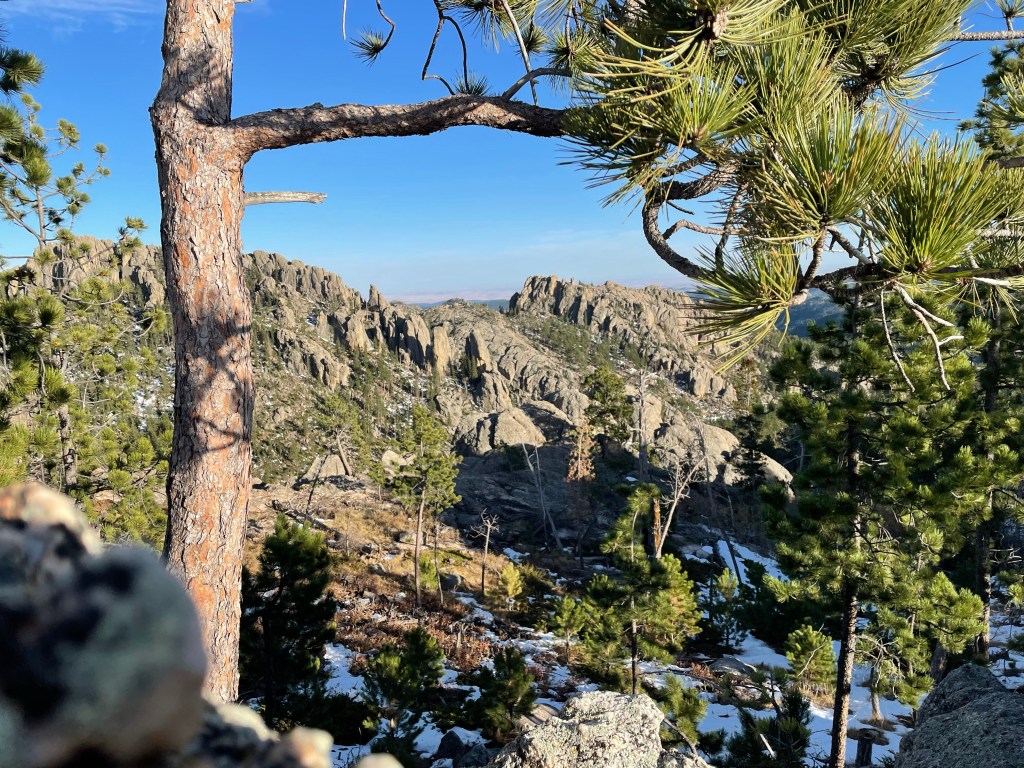
I had compiled various online sources into a curriculum to guide the teachings I hoped to instill into my kids. We didn’t get to do everything that I had planned, but the beauty of being able to go with the flow is just having a good time no matter what. The Needles highway was closed due to snow so we parked by Sylvan Lake and walked over to the edge of the Cathedral Spires. It was a beautiful day with a mix of snow and mud on the trail so we took our time and discussed the history of the area and the implications of having the land stolen. The disparities between the Pine Ridge Reservation and towns such as Custer were immense. The kids saw with their own eyes the wealth and opportunity that was displaced due to the atrocities of the US Government.
Day 2 : History of Wind Cave
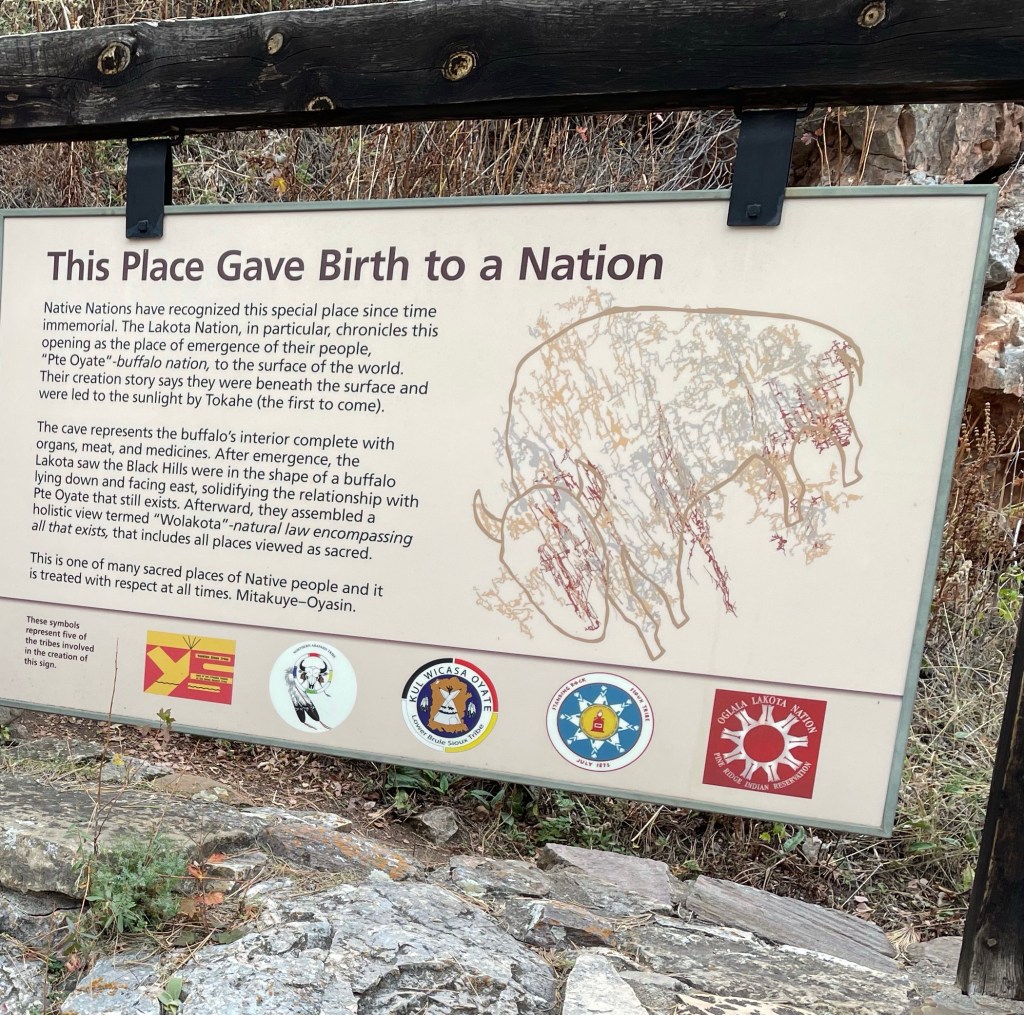
We were expecting a snow storm to hit around noon so we decided to stick close to camp. We arrived at the Wind Cave Visitor Center around 9:30 am and the 10 am tour was already booked so we paid for the 11:30 am Garden of Eden tour. This is one of the nicest visitor centers I’ve taken the kids to and we had no problem spending that unexpected free time exploring the exhibits. Since we had to wear masks inside the visitor center, I had the kids hang out in the car for a bit before our tour to eat a snack while I read them the Wind Cave origin story of the Lakota. When it was time for our tour we put our masks back on and joined a group of around 30 people. Our tour guide was fantastic and we were in awe of the history and development of the cave. One thing that stood out most was the fact that only five percent of the cave has been explored. I felt so calm inside of the cave, almost like being hugged by mother earth herself. I thought was an interesting reaction as typically I’m very stressed when in large groups of people. My oldest expressed how fascinated he was with the geological history of the cave and our guide told us to check out local caving groups to experience more of history and preservation of caving in Colorado. There is certainly a delicate balance in honoring and respecting the land along with the desire to research and understand it.


We were fortunate that the storm stalled until 6 pm that evening. This was the first time my children have camped in a snow storm and they were nervous. Freezing rain fell as we were finishing dinner and I quickly prepared our campsite to hunker down for the night. We could hear snow forming after we snuggled up into our tent while playing What Do You Meme. The kids thought it was amusing to whack the sides of the tent every so often to prevent the snow from accumulating on top of our tent. I was thankful that the wind was not bad and our tent held up well. We all slept very well and woke up to quite a bit of condensation inside of the tent due to how toasty we were. We were dry otherwise and peeked outside to find a couple inches of snow. The kids were relieved and felt more assured that they could handle camping in freezing temperatures with snow.

Day 3: Travel Back in Time
I’m grateful for the opportunity to work and give my kids a memorable fall break trip. I took the first two days off, but the remaining two days I had virtual meetings and obligations to attend to. We set off early to the town of Hot Springs to get situated for me to work. The kids kept themselves occupied by observing the wild animals such as deer, turkey, and rabbits. There was a walking path alongside the river and a gorgeous waterfall with warm water. They stayed close to me while I was able to use my hot spot to complete my work duties.
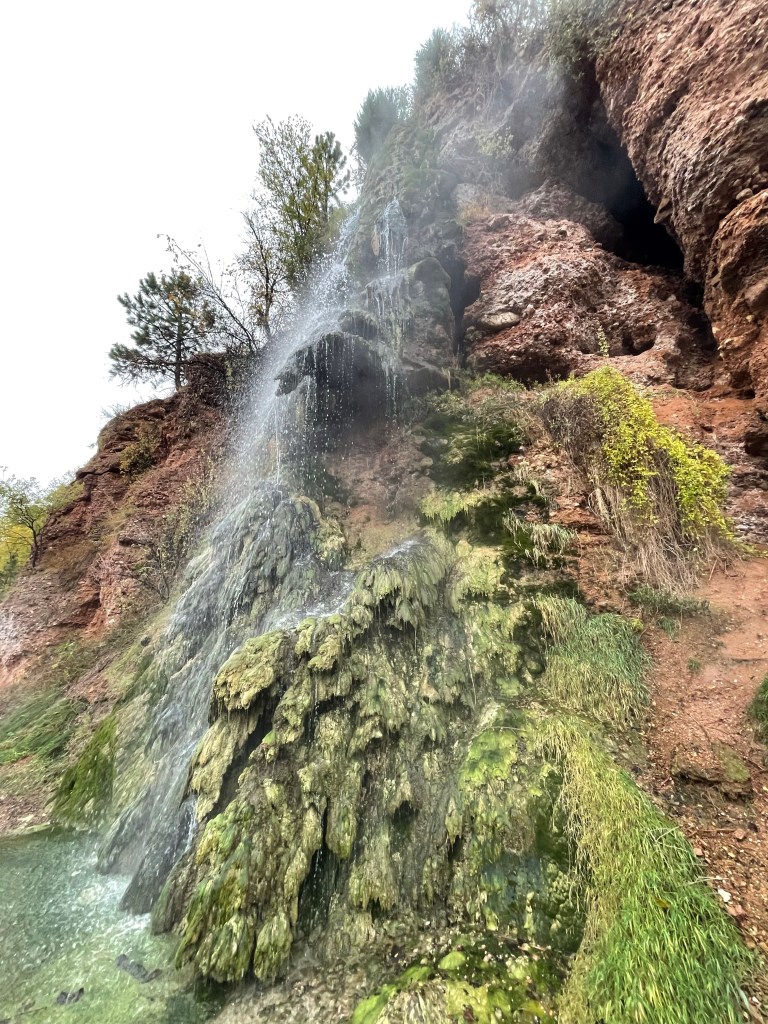
During my lunch break we went to the nearby Mammoth Site Museum. It was mind blowing to realize that we were standing in the remnants of a 140,000 year old sinkhole. The mammoth specimens were spectacular and the self guided booklet offered an individualized experience. The exhibits and every aspect of the museum was very memorable! They have not excavated all the mammoths yet, so it is definitely worth visiting again. When I had to get back to work, I let the kids hang out at the adorable Hot Springs Library to enjoy reading new books while I completed my work uninterrupted.


At the end of my work day we headed north to Crazy Horse Memorial. It had been cloudy all day from the leftover snow storm, but when we neared Crazy Horse it opened up to the sun illuminating the sculpture. I actually had never heard of this place before and it wasn’t even on my itinerary for this trip. We had passed it on our first day in the Black Hills and I decided it was worth checking out. OH MY GOSH this place is amazing! The fee covers three museums, countless education on indigenous teachings and art, along with the awe inspiring story of the Ziolkowski family and their dedication to honor Chief Henry Standing Bear’s request. One could easily spend several hours here with the amount of art, history, and hope for the future to observe.


I was apprehensive about visiting Mount Rushmore due to the history of disrespect. I thought it would be another teaching opportunity to visit it and explain to the kids the impact it had on the indigenous people in the Black Hills. It was only 20 minutes from Crazy Horse, but when we neared less than halfway a thick fog rolled in. It was so thick we could not see any of the landscape besides the road. When we arrived to turn into the parking lot of Mount Rushmore it was evident that we would not be able to see anything so I turned around. It felt symbolic to have Mount Rushmore in a thick dense fog and the Crazy Horse Memorial in sunshine.
Day 4: Words Matter
I woke up at 4 am to break down camp which took over an hour because everything was frozen including the tent poles. We headed north into the Black Hills for the last time on our trip. My car was slowly defrosting as we headed into the pitch black darkness illuminated by the setting full moon. The fog on my drivers side window was slowly dissipating. The kids were falling back asleep and I was silently thanking the spirit of the Black Hills for allowing me to teach my children what it means to be resilient from the stories of the land. I looked up at the moon to see that it had an aura of colors around it and a bright cross of light expanding into the four directions. It looked like a medicine wheel and I began to cry at the sight of such beauty. That image made me feel like my intentions of the teachings I set out to provide for my children were accepted by the Great Spirit. The two hour winding drive from Wind Cave to Devil’s Tower in the dark was very peaceful. The sun had just reached the horizon when I could see the tower in the distance. I was so excited as I had always wanted to pay my respects at this monument. I was pleasantly surprised that there was strong cell service at the bottom of the park so I could complete my work.
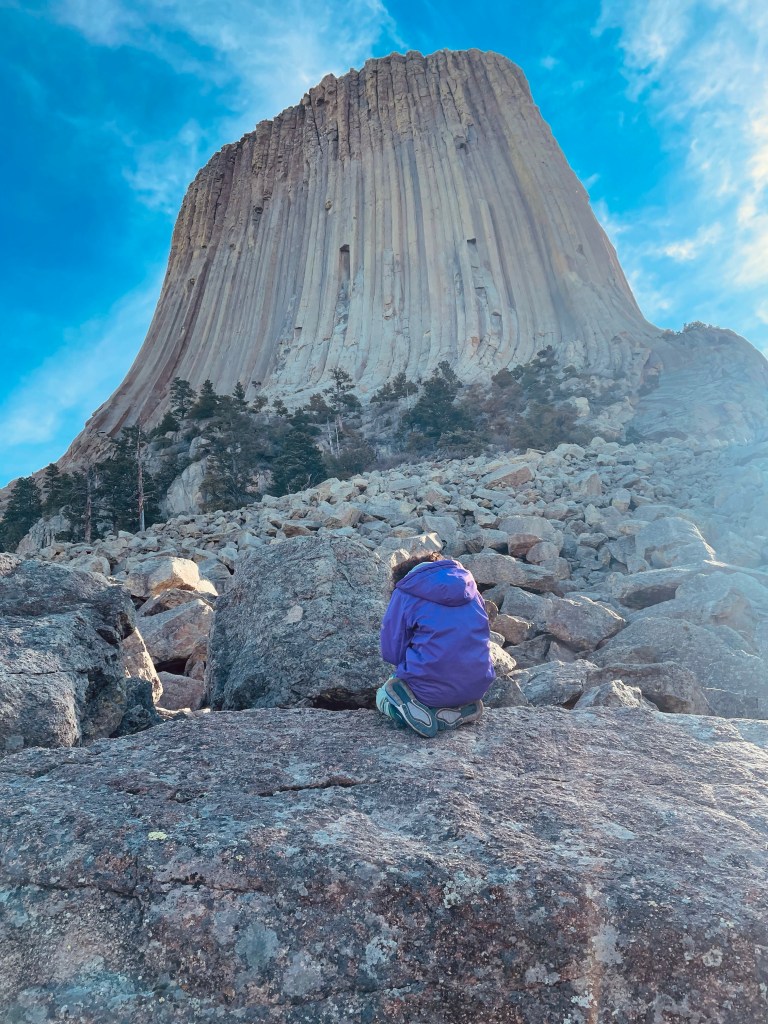
At lunch time the kids and I headed up to the visitor center to learn about the tower’s history. We walked along the concrete path that surrounds the base of the tower. We learned that the name Devil’s Tower is not only incorrect, but it is disrespectful. It should be called Bear Lodge. The reasons of why the change was denied is infuriating and just adds to the mountain of suppression the indigenous still face today. I found it interesting to see signs asking people to respect the prayer bundles/ties and not to take photos of them, yet people did it anyway. I pointed out to my kids the impact of social media on how we are treating land and sacred traditions. It is my hope that my kids won’t rush out to do something just for the sake of attention or number of engagements on their page. We each sat at the base of Bear Lodge and thanked the spirt of the Black Hills for its wisdom and keeping us safe the past four days of our journey. It warmed my heart to see the sincerity of my kids’ gratitude.


I believe visiting Bear Lodge was the perfect ending to our journey. The kids got to see a good portion of the Black Hills and how the forced removal of the native people has resulted in harm to the land and generations of human beings. My children have thanked me numerous times for taking them on this trip. They found out that they are stronger than they thought. They also learned that they are far more blessed than they have ever understood. They realized this by seeing the disparities with their own eyes.
My takeaway is that we have to let kids be uncomfortable at times to make them better people. Giving them everything we never had isn’t going to create better people. We can give them better experiences than we ever had and that will make a lasting impact. Instead of buying excess things for your kids, give them humbling experiences. That will turn them into the adults the world needs. They will bring the unity we desperately need as a human race.


 We Heal Wild
Leave a reply to tianaexplores Cancel reply